
The Bridge that Must be Saved
It’s time to leave Virgil and follow Beatrice across the bridge of art

This piece is near the email length limit, I suggest you read the original here
This piece originally appeared on my personal Substack, Clinsights, here.
Editor’s Note: In two days, this post will be locked and is available only to paid members because we don’t want this duplicate content on the open web in a way that might draw traffic away from the original post. You can always read the entire post here.
If you wish to comment on this piece, we are accepting comments on the original post here.
The Bridge that Must be Saved
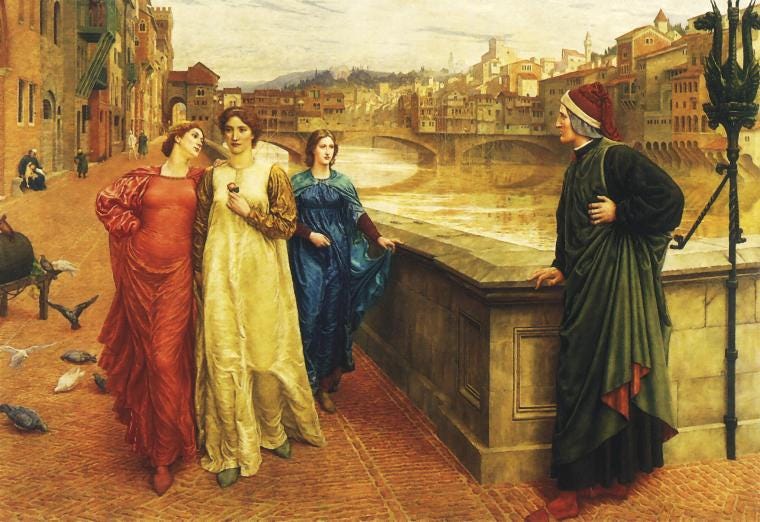
“Foolish people concoct a false notion of beauty, reducing it to the level of their senses, beauty comes from heaven and will lead any sane spirit to the place from which it came”
— Michelangelo
When Dante Alighieri was nine years old, he attended a gathering in Florence where he saw a girl that changed the course of his life. Her name was Beatrice Portinari. The instant his eyes landed upon her, his heart opened, he received the divine arrow of beauty, and wonder awakened in his soul.
He did not speak to her. But something sovereign had awakened within him.
Dante later wrote that “Love itself” took possession of his heart — not as a feeling, but as a force. His body trembled. His inner world reorganized. He famously wrote of Beatrice that, “She seemed not the daughter of mortal man, but of God.”
For Dante, Beatrice represented far more than a person. She was Beauty made visible; a doorway through which the invisible mystery entered his life. During his lifetime, they exchanged only the smallest courtesies. Yet that single encounter shaped everything he became. Beatrice became his muse.
From that moment forward, Dante lived in quiet devotion to wonder. Out of that awakening came his poems. And ultimately, out of that one brief glimpse of Beauty, came a vision of heaven and hell — one of the greatest works of art humanity has ever created.
When Dante’s gaze landed upon Beatrice, it led to his initiation, not into a romantic relationship, but into divine inspiration; into wonder; into the realization that beauty is not mere decoration, but that beauty is instruction.
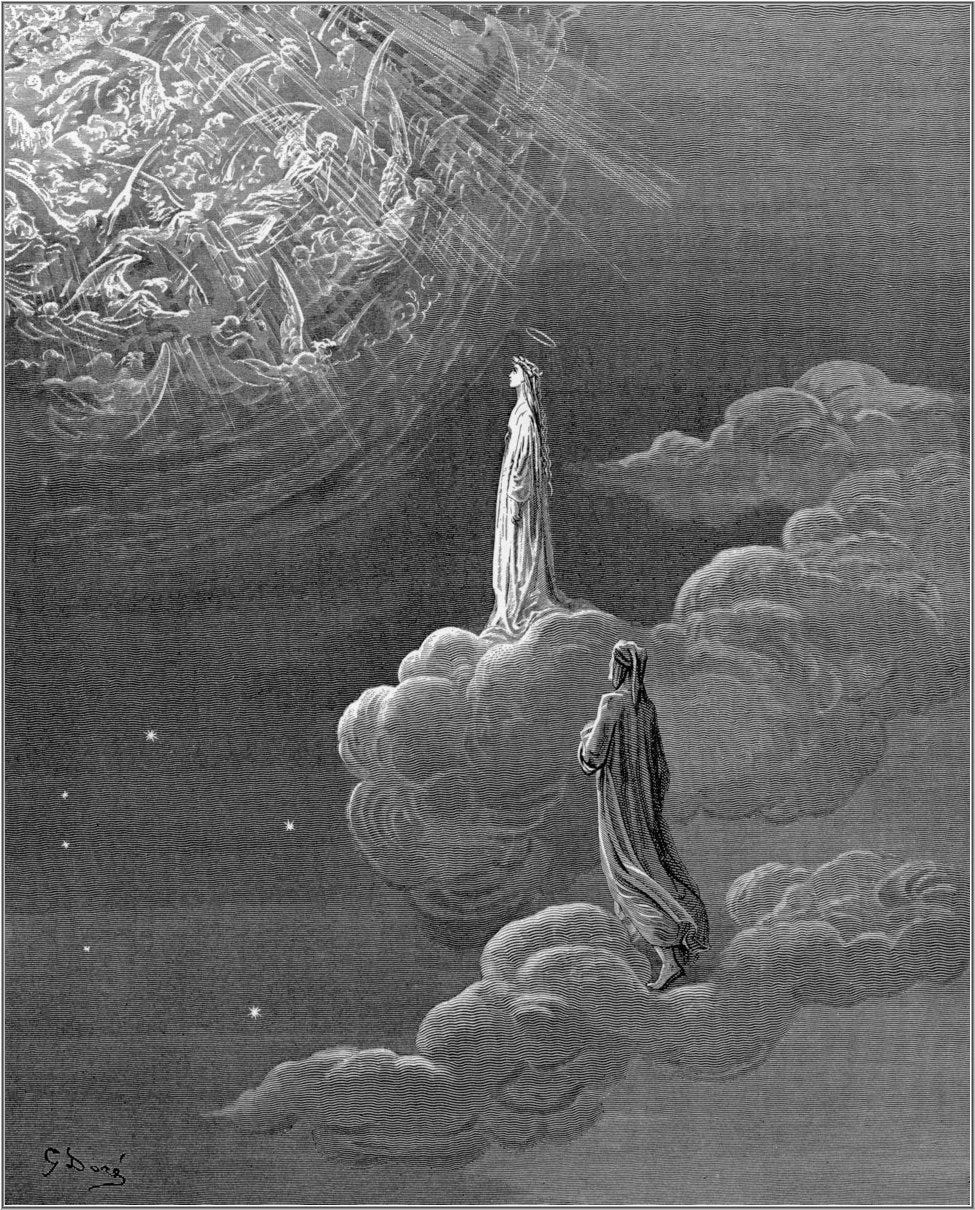
In The Divine Comedy, Dante gives us one of the most enduring metaphors in Western thought: The Roman poet Virgil, representing the human intellect, guides Dante through Hell and up the long ascent of Purgatory, all the way to the peak of Earthly Paradise. And there, reason reaches its limit. Virgil can go no further. He disappears.
In his place, Beatrice appears.
This moment is not merely narrative; it is philosophical and spiritual. Intellect can illuminate, discipline, and orient us. It can carry us remarkably far. But it cannot usher us into The Mystery. That requires something else.
For Dante — and through The Divine Comedy, for much of Western culture — Beatrice becomes an icon of transcendence itself. She does not reason Dante into paradise. She draws him. She transports him there. Through beauty. Because Beauty is how the divine reaches out to us.
And so, Beatrice — embodying beauty — reveals divine love to Dante, becoming his bridge to salvation.
There is an old legend, reflecting the mythic power of Dante and Beatrice, that is still told among Florentines.
In World War II, as the German army retreated from Florence, orders were given to destroy all bridges over the Arno River. They blew up the bridges — one by one — until only the Ponte Vecchio remained.
According to the legend, the German demolition officer stood before the famous bridge and refused the command, saying, “This is the bridge where Dante met Beatrice. I cannot possibly destroy it.”
So he informed the Allies that the Germans would spare the Ponte Vecchio if the advancing forces would refrain from crossing it. Amazingly, the Allies agreed. The old bridge escaped destruction. What became of the officer is unclear. Some say he was executed for disobeying orders.
Historically, parts of this story are almost certainly apocryphal. Dante did not meet Beatrice on the Ponte Vecchio. The real reasons the bridge was spared are likely more complicated.
But Florence still tells the story. And that matters. Artistic beauty prevailed over military logic.
The legend survives because it is Art, and Art carries a deeper symbolic Truth than literal historical facts can hold.
“Artists are people who are not at all interested in the facts—only in the truth. You get the facts from outside. The truth you get from inside.” — Ursula Le Guin
That truth is this: Art protects what force would otherwise erase.
I first heard this story from Eugene Terekhin, who tells it not as a historian, but as a theologian of beauty. He tells it as a parable. That’s how I want to use it here.
Because the point is not the Ponte Vecchio, specifically, but the archetype it represents: A bridge that must be saved. The Ponte Vecchio, the “old bridge,” becomes icon that points to the oldest bridge of all:
Art, you see, is the language of the soul. Art transmits love through form. Art unites us with each other and with God.
Art itself is the bridge.
Art, and especially the drive to create it, is a divine bridge from the visible to the invisible; from the finite to the eternal; from one human heart to another; from the world to The Mystery; from hell to paradise; from sleepwalking to awakening.
Art is Beatrice.
Dante crossed the bridge the day he first saw Beatrice. And so does every artist, every creator, and every soul who has ever been seized by Beauty and compelled to respond; to create.
The legend survives because it is poetic — and because it reminds us of something we’ve nearly forgotten.
And in our forgetting, we’ve allowed something to go wrong with the modern world.
The bridge is under threat — not from bombs, but from distraction; from commodification; from media; from ugliness; from reduction; from a materialism that denies the soul; from machines that churn out endless simulacrums of art. As we, the artists, retreat, the bridge is threatened by a culture that treats beauty as optional, art as entertainment, and creativity as “content.”
And, while the world quietly prepares to blow up the bridge, most people don’t even notice. They accept the programming that rewards speed over depth, utility over meaning, and efficiency over soul. We are taught to optimize, monetize, and scale; but never to see, never to feel, never to listen.
We have forgotten the whisper of wonder. We have forgotten to kneel before beauty. We have forgotten ourselves. The result is a civilization rich in tools but poor in spirit; a world full of noise but starving for music.
We are like Dante, in the first stanza of his epic poem, finding ourselves, “within a dark forest” where “the straightforward path has been lost.”
But there is a way out of this darkness.
The German officer in the story did one simple thing: He opened his heart. He recognized Beauty. He felt wonder. He remembered. And he refused to destroy.
That is our task now.
We must become guardians.
We must stand before the “Bridge of Art” and say:
“I cannot possibly allow this to be destroyed.”
We must protect the fragile, luminous thread that connects us. We must remember that the creative act, and the art it creates, is not a luxury, it is a lifeline.
Because when Art disappears, something essential collapses with it. And when Art survives, so does the soul of the world.
Art protects what force would otherwise erase.
Years ago, I found myself in Dante’s position: in the middle of life, suddenly awake, lost in the prison of those dark woods, and desperately searching for a guide.
Then I rediscovered that Beauty, Art, and especially the creative act itself is the method of walking across that bridge. It is the bridge to cross out of the dark shadowlands and back into freedom; into liberation; into sovereignty; for the Bridge of Art is a bridge home, to the Self.
Let me be your Virgil. I’ll walk with you as far as I can, until you glimpse Beatrice. Only she can take you all the way home.
PS - This is the revised intro to my forthcoming book The Sovereign Artist. If you wish to join the waitlist, please click here.
PPS - This piece reflects our vision, at FASO, of the importance of art. We are committed to, and are building tools for human artists. Art is more important than ever before — possibly more important than it has ever been. Humanity urgently needs an awakening. I believe that will not happen without more art and artists becoming a counterforce to The Machine of modernity. If this vision resonates with you, then you should consider working with us.
“The soul is stirred by beauty, and remembers its wings.” — Plato
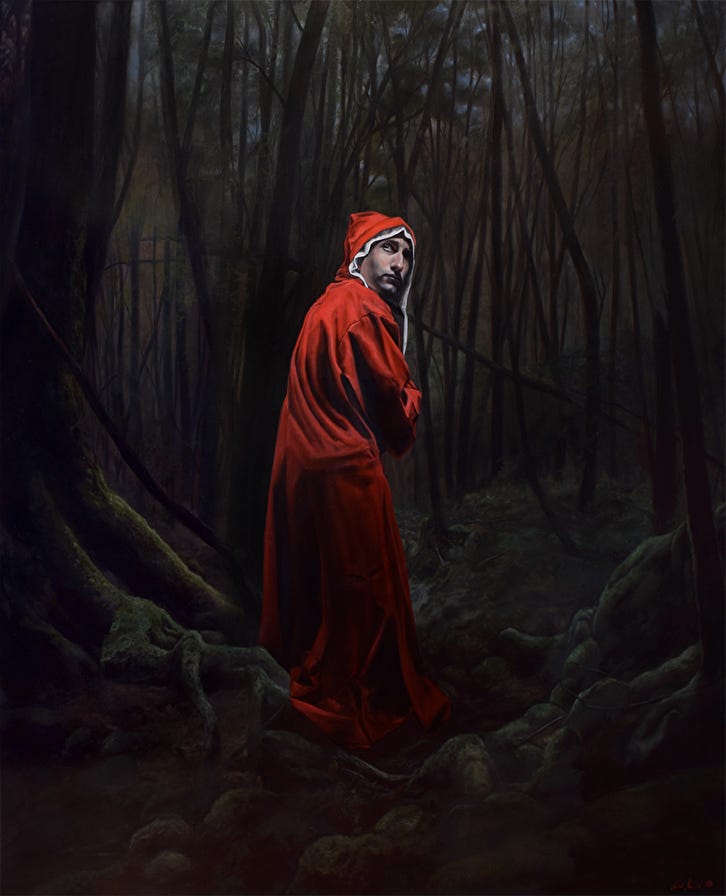
Midway upon the journey of my life
I found myself within a dark wood,
For the straightforward path had been lost….
— The Divine Comedy, Canto I, Stanza I

FASO Loves Angela Muellers’ paintings
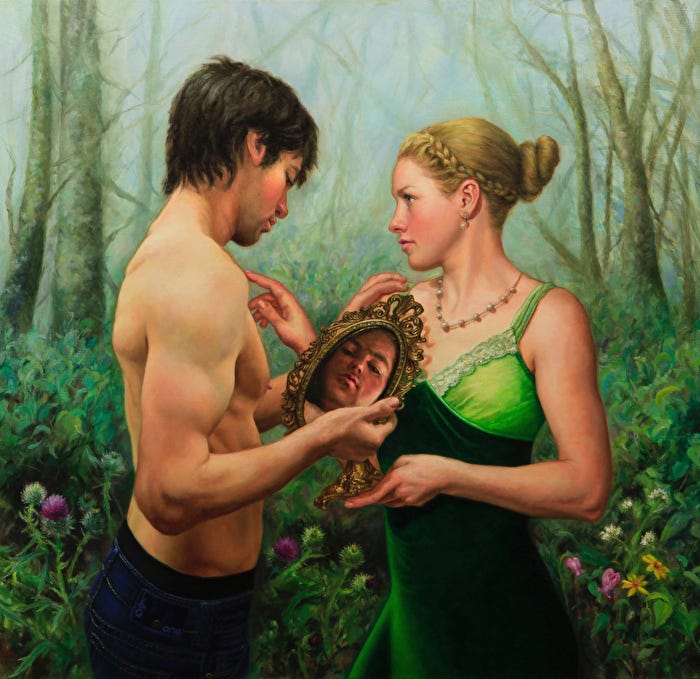
Wouldn’t You Love to work with a website hosting company that actually promotes their artists?
As you can see, at FASO, we actually do, and,
we are the only website host we know of that does.
Click the button below to start working
with an art website host that actually cares about art.
PS - If you prefer Squarespace websites, you should check out our Artful Square offering. We can generally save artists money, unlock extra features, and we promote our Squarespace artists too!
Thank you for the inspiration to bring beauty and love to the world. We’re tired of propaganda, fear and hatred. Artists are taking action and sharing my art is helping me cope and align with those who still have souls.
Creating art is my escape from the difficulties of life. If nothing else, it keeps me sane.