

The FASO Way newsletter — exploring how to thrive as an artist in the age of AI
Today’s Newsletter is Brought to You by FASO.
FASO Loves Michael Smelcher’s paintings
SPRING SALE - SAVE 52% ON FASO FOR A LIMITED TIME
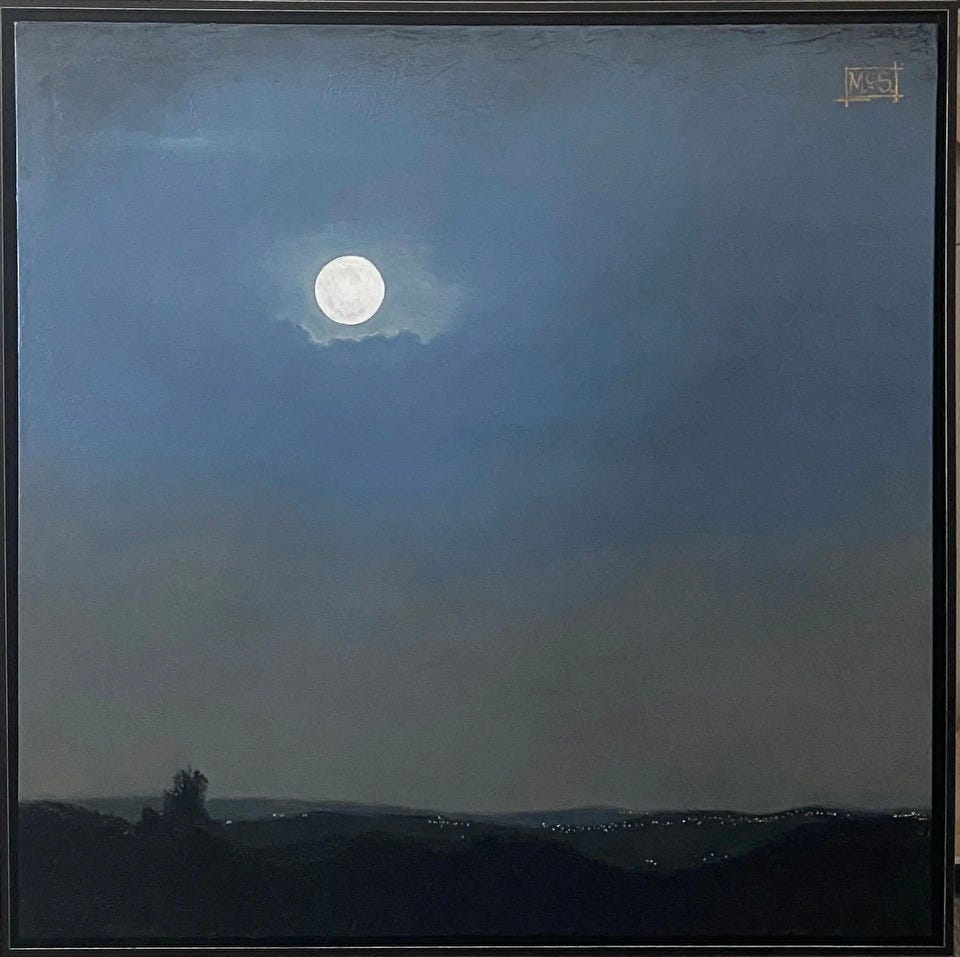
Wouldn’t You Love to work with a website hosting company that actually promotes their artists?
As you can see, at FASO, we actually do, and,
we are the only website host we know of that does.
Click the button below to start working
with an art website host that actually cares about art.
Just activate your account before before your trial expires to save 52% on your first year.
This piece originally appeared on my personal Substack, Clinsights, here. It has been edited and improved for publication in The FASO Way.
Editor’s Note: In two days, this post will be locked and is available only to paid members because we don’t want this duplicate content on the open web in a way that might draw traffic away from the original post. You can always read the entire post here.
If you wish to comment on this piece, we are accepting comments on the original post here.
The Mystical Song of Creation in Starry Night That Inspires Man to Go to the Moon
by Clint Watson, FASO Founder
On April 1st, millions of people tuned in to watch as NASA launched its new Artemis II rocket, which carries four astronauts bound for the moon, the biggest “star” in the night sky, for the first time in fifty-three years.
Man has always looked into the night sky and been overcome with a longing; a remembrance; a Desire to reach for the stars: A Heavenly Desire.
Desire, in its truest sense, is from the Latin de sidera — of the stars. True Desire is not of the earth. Earthly desires are more appropriately called appetites, but The True Desire is a deep longing to ascend to the stars and rejoin the Divine.
Even the word heaven, as Jesus uses it in the Gospels, is more accurately translated as sky or cosmos.
In The Chronicals of Narnia, stars are presented as conscious beings. Eustace, in The Voyage of the Dawn Treader, talks with a star named Ramadu:
“In our world,” said Eustace, “a star is a huge ball of flaming gas.”
Ramandu replies, “Even in your world, my son, that is not what a star is but only what it is made of.”
Eustace’s description of stars as flaming balls of gas is not false, but it is incomplete. Stars are not mute. They sing to us.
In our world, just as in Narnia, the stars are up there, in the heavens, singing to us, reaching out toward us, calling us with that ancient song that we all long to rejoin; a song composed of light. It is a song they sang, patiently, for eons before their melody entered our mind through our eyes.
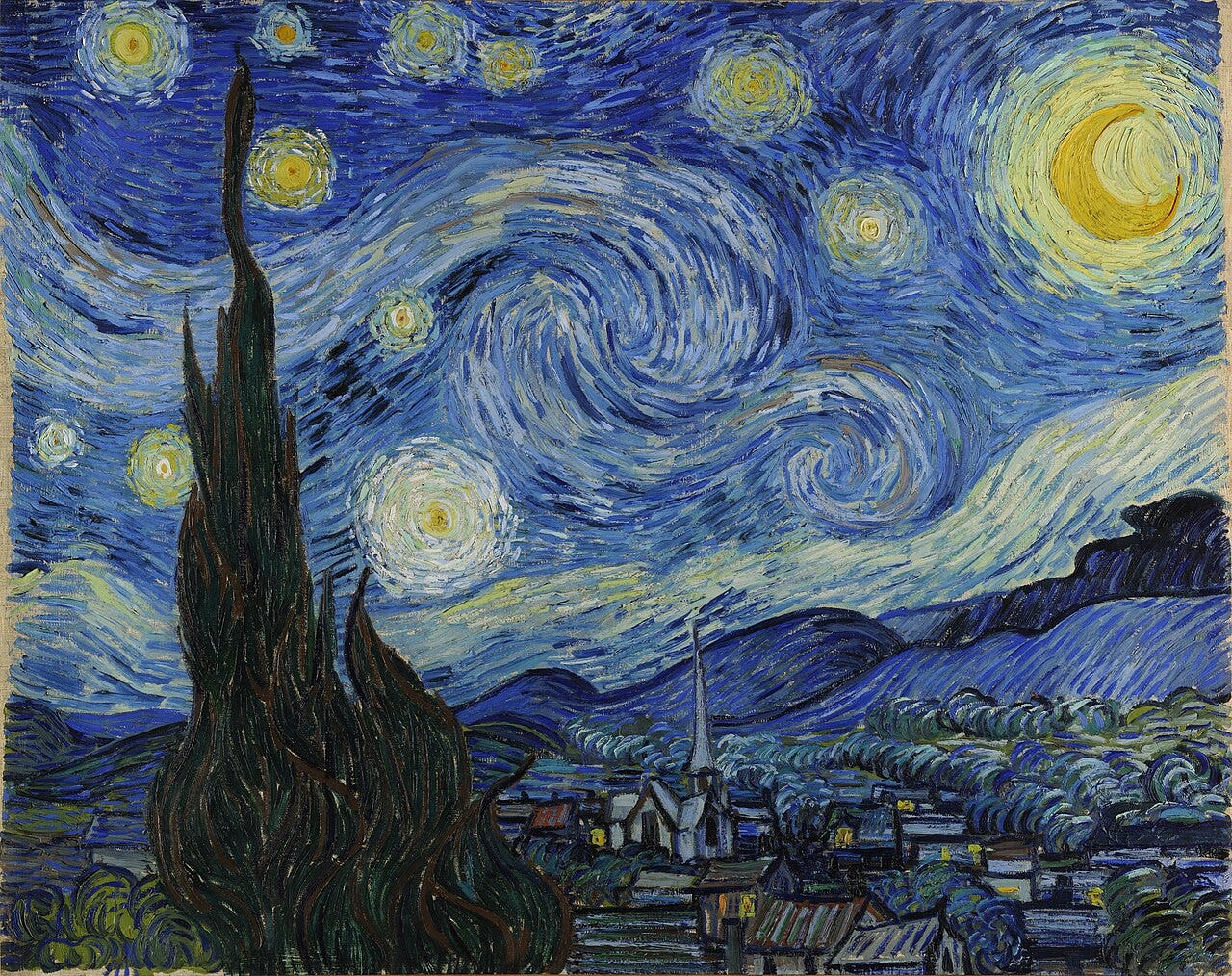
This singing of the stars is echoed in Van Gogh’s Starry Night. In it, one can see this primordial oscillation driving the movement of life throughout the famous landscape.
The sky is alive in a great, sweeping melody—spiraling and dancing. The stars aren’t depicted as mere “balls of gas.” They appear as blazing vibrations, broadcasting their voices outward, inviting creation itself to sing. In the foreground, the dark flame of the cypress rises, like a rocket, in its longing to join them. In the background, the mountains rumble with the low, steady gravity of bass. And the village, nestled in the great song’s bosom, breaths in and breaths out with the rhythm of life.
Everything participates. Nothing is inert. The whole canvas lives.
And there, in the upper right corner, is the queen of the night stars, the moon, the heavenly choir director, leading the song with her warm, ethereal voice.
This is the musica universalis—the music of the spheres—made visible. This is nature as revelation. This is where God is encountered; the moving, wild, luminous God of Life.
And then we notice the church.
It sits at the village center, its windows dark, unlit, silent – lifeless. While everything else vibrates with life, the church feels sealed off — closed to the song that pervades the rest of the world.
The contrast speaks for itself, serving as a subtle critique of our religious misunderstandings, hinting at the truth that we find God everywhere — except in the artificial, idolatrous boxes we insist on stuffing Him-Her into.
But we have always preferred gods we can manage, haven’t we?
Those kinds of gods stay indoors and follow rules. We forget the truth that The Mystery is everything except what man thinks it is. The living God cannot be contained, and The Kingdom does not arrive in straight lines or tidy boxes. It is unveiled only in the song of life where rhythm, unpredictability, and movement prevail. God dwells where Life dwells.
“Your religion is not the church you belong to, but the cosmos you live inside of.”
— GK Chesterton
The stars remind us of this. They will not squeeze themselves into our boxes. Instead, they sing. The Logos sings continuously, gifting us with the ever-changing possibility of the present. The Song gifts us time as a canvas upon which we are invited to paint something creative. We are invited to create, in the image of the divine vine, of which we are all branches.
C.S Lewis knew this and Van Gogh saw this truth. The song plays evermore, calling out, to you, calling out your true name, kindling the one True Desire in your heart. A desire born of the stars — de sidera.
This Desire exhorts you to see and to hear; for the only way to create harmony; to create Art, is to tune into the one song with your spiritual eyes and ears so that you hear the entire symphony that is waiting for you. It’s waiting for you to step away from the scales of dogma, and to, instead, start playing your soul’s unique harmony. That is the Desire you feel when you gaze into the night sky.
And the moment you begin to play is moment the whole symphony has been waiting upon.
Godspeed, Artemis II.
May our prayers, and our shared song, buoy you upon a wave that carries you forth into the cosmic symphony.

PS — If you’d like a print of Starry Night, we have it available in many different formats, framed or unframed, in the FASO Print Gallery. Should you desire Van Gogh’s masterpiece for your own walls, ordering it from us would help support what we are doing.

Van Gogh’s Starry Night — Prints Available
Clint, I love this so much! I've just completed reading a book about Van Gogh and I love the energy he put into Starry Night! Are you familiar with Richard Rohr? He wrote The Universal Christ, which reminds me of this article! Thanks for such a thoughtful article!
Your words speak as the paintings do..to the heart of things that live. Thank you for sharing your beautiful words