
How to Stand Out in a Crowded Art World: 9 Key Strategies
From reviving her practice to mastering maximalism, Maureen Dunlap shows that standing out requires technical skill, patience, unique personality, and business sense.


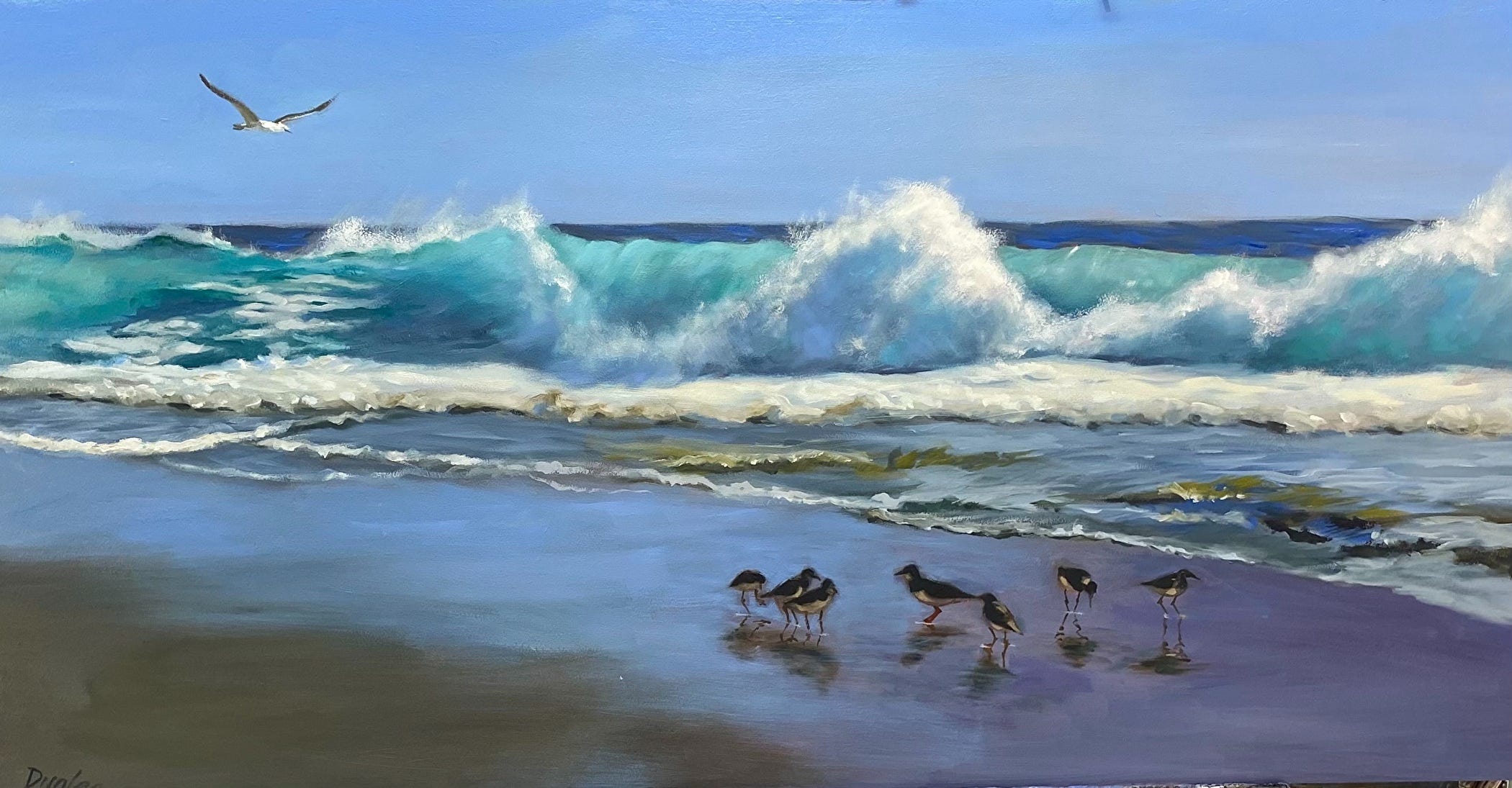
“I love, love, love doing it, and so I do it for love, not for money.” — Maureen Dunlap
❤️ Please click the Like button—the little heart icon at the top and bottom—to release a paint-splattered muse into the internet. She is searching for a kindred spirit—an artist who needs Dunlap’s advice on patience, business sense, and technical mastery. With one tap, you place a paintbrush in that artist’s hand, whisper a secret recipe for standing out, and help carry a vital spark of encouragement to other artists who need it most.
In an art world overflowing with images, talent alone does not guarantee that an artist will be noticed. Maureen Dunlap understands that challenge firsthand. After beginning her artistic education as a child, spending decades working in typography and software development, and eventually returning to painting full time, she had to rediscover both her abilities and her artistic identity.
In this episode of the FASO Podcast, Dunlap explains how she transformed traditional training, technical curiosity, personal humor, and a love of historical art movements into work that feels unmistakably her own. Her experience offers a valuable lesson for any artist searching for a clearer voice or a more sustainable career: Setting yourself apart is not a single marketing decision. It is something you build into every layer of your practice.
1. A distinctive artistic voice begins with understanding why things look the way they do.
Dunlap began studying oil painting at the age of ten and later trained under Arthur Maynard, whose approach emphasized observation rather than imitation. He did not merely teach his students how to reproduce an object. He taught them to understand the physical behavior of light, color, value, and form.
As Dunlap recalls, his guiding principle was: “You’re not painting this apple; you’re painting the light that’s hitting the apple.”
That distinction shaped the way she approached everything from still lifes to portraits. When an artist understands why a face contains warmer color in certain areas, why an object recedes, or why a particular value makes something appear to move forward, technique becomes more than a collection of instructions. It becomes a flexible language.
This kind of understanding also creates independence. Artists who know why a technique works can adapt it, exaggerate it, or deliberately break its rules. That freedom is one of the foundations of an original style.
2. A career detour can become part of an artist’s creative education.
Dunlap’s path was anything but linear. After becoming disillusioned with an art-school environment that was no longer interested in teaching the traditional painting she loved, she studied illustration, typography, graphic design, and layout. She eventually became a web designer and front-end software developer.
Although these occupations took her away from painting for years, they continued to develop skills that would later strengthen her artistic practice. Coding taught her to solve problems systematically. Photo-editing software helped her construct detailed reference images. Video editing and web development made it easier for her to promote her work online. The precision demanded by software development also reinforced her natural attention to detail.
“The coding, of course, probably doesn’t really translate,” she says, “but maybe the persistence does, because I would have to make sure I got the job done. I had to do a lot of research and redoing, and that made me very detail-oriented, which is critical in software development. I find that I’m very detail-oriented now in my painting.”
An artist’s previous career does not have to be erased when art becomes the primary pursuit. The patience, discipline, technical knowledge, communication skills, and problem-solving habits developed elsewhere can become part of what differentiates the work.
3. Returning to art requires accepting that the first attempts may be disappointing.
Dunlap went approximately fifteen years without picking up a paintbrush. When she finally returned to oil painting, she initially feared that she had lost her abilities.
Her recovery did not come through a sudden burst of confidence. It came through mistakes, unsuccessful paintings, closer attention to composition, and a willingness to continue working while she was still rusty. She also learned not to judge a painting too severely during its earliest and least attractive stage.
“The first pass of a painting can look horrible,” Dunlap says. “A lot of people think, ‘Well, that’s it. I guess I’m not a good painter, because it looks like a kid did this.’ Yes, it does, but you’ve got to have that underlayer. That’s your underpainting.”
A rough beginning is not proof that a painting has failed. It may simply mean that the painting has not yet been developed. Dunlap advises artists to contemplate what the work needs, put it aside when necessary, and return with a clearer eye. She also accepts that some paintings will never become masterpieces, regardless of the time invested in them.
That acceptance is not defeatism. It is what allows experimentation to continue without turning every imperfect result into a judgment about the artist’s worth.
4. Slowing down can reveal both a stronger process and a more personal style.
When Dunlap first returned to painting, she worked primarily alla prima and could sometimes complete a painting in a day. The speed was satisfying, but it also created a practical problem. Paintings accumulated quickly, while canvases and supplies continued to cost money.
Instead of increasing her production, she asked a more interesting question: How far could she take a single painting if she allowed it more time?
“I thought, ‘This is not sustainable, because I’ve got to buy more canvas and more paint. Let me slow down and see how far I can take it.’”
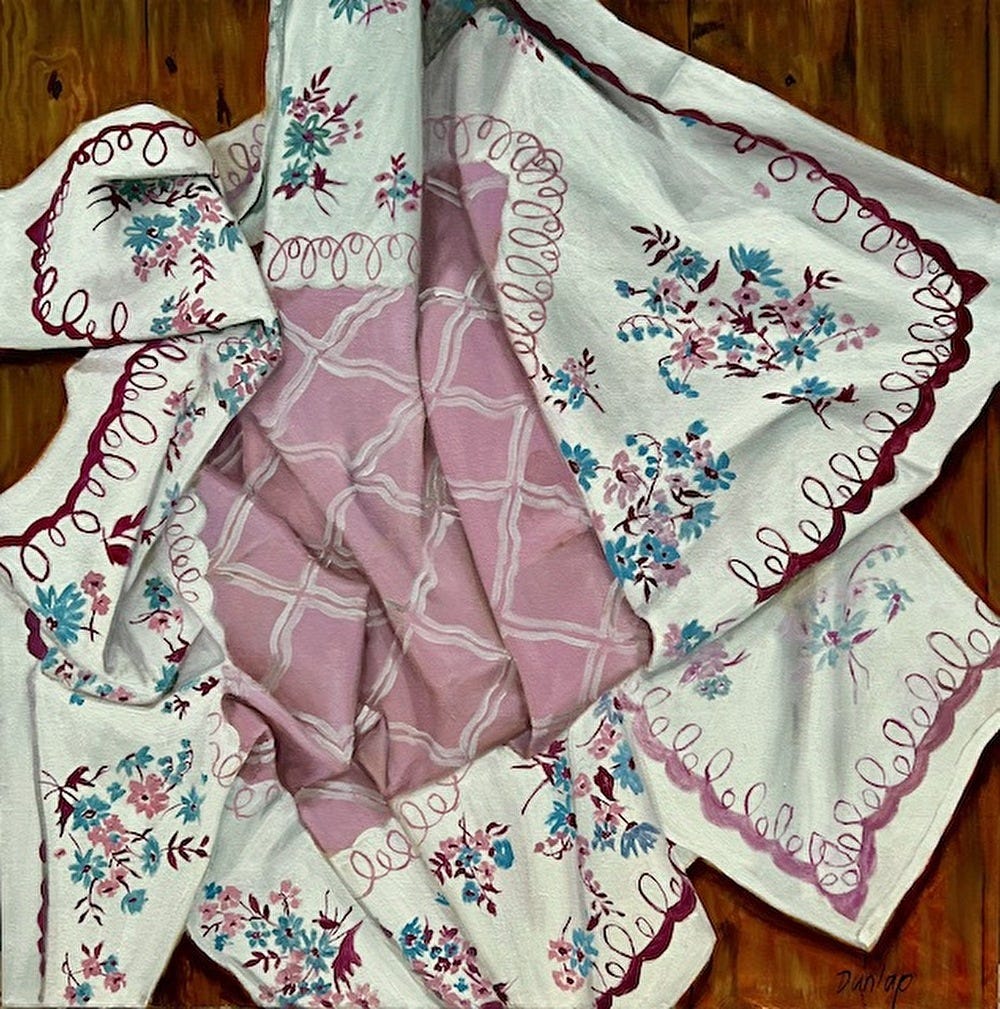
That decision led her toward indirect painting, underpainting, glazing, and carefully built layers. She began challenging herself with elaborate surfaces, including vintage lace tablecloths and intensely developed details. Slowing down did more than change her technique. It led her toward the visual density and refinement that now distinguish her paintings.
In a culture that often celebrates productivity, an artist may assume that success requires producing more work more quickly. Dunlap’s experience suggests that deliberately reducing output can create room for greater ambition, stronger craftsmanship, and a more identifiable artistic language.
5. Artists can draw from tradition without becoming trapped inside it.
Dunlap does not hide her influences. Her work draws from Art Nouveau, Art Deco, the Pre-Raphaelites, the Baroque period, Alphonse Mucha, Maxfield Parrish, and John Singer Sargent. She combines those references with vibrant color, dramatic value contrasts, fantasy, portraiture, florals, seascapes, gold leaf, and an unabashedly maximalist sensibility.
Her originality does not depend on inventing a style without precedent. It comes from selecting, recombining, exaggerating, and personalizing the things she loves.
She pushes darks and lights beyond the cautious middle range, intensifies color, surrounds paintings with ornate vintage frames, and sometimes paints trompe l’oeil frames directly onto the canvas. When a physical object does not exist, she gives herself permission to invent it.
She says “You don’t have one, so just make it up. You’ve got the power of creation in your hands.”
The lesson is not that every artist should become a maximalist. The lesson is that recognizable work often emerges when artists stop apologizing for their strongest preferences. Taste becomes style when it is pursued consistently and developed with skill.
6. The presentation surrounding the artwork can reinforce the artist’s identity.
Dunlap’s personality does not stop at the edge of the painted surface. It appears in the frames she chooses, the stories she imagines, the series she develops, and the humorous titles she gives her paintings.
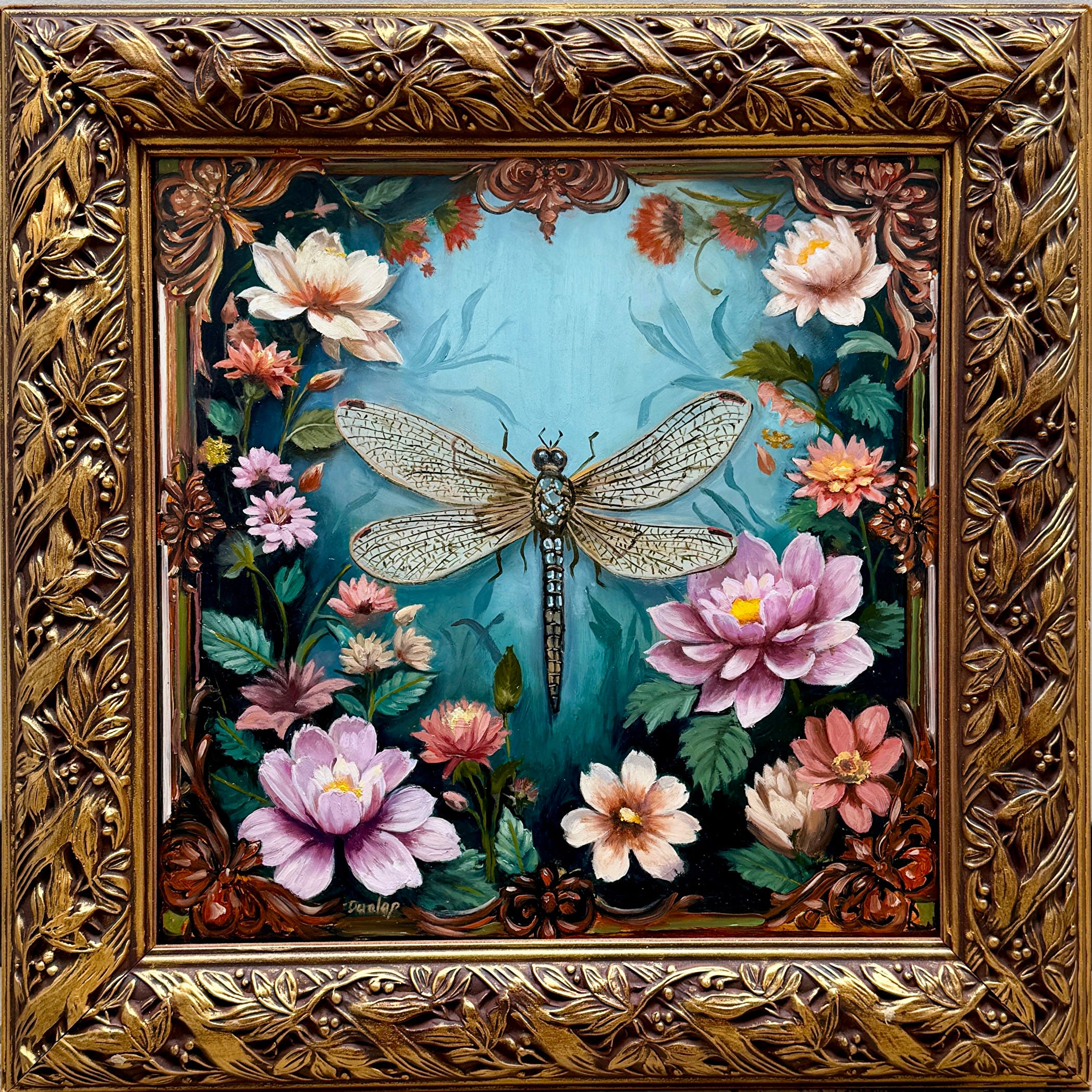
One painting is titled Too Much Is Never Enough, a phrase that captures her entire maximalist philosophy. Another, created as a study of voluminous blond hair, is called Blessed Be the Hair Volume. A painting of birds engaged in an imagined secret meeting became Rendezvous. These titles invite viewers into her world and give them something memorable to carry away.
She also understands the power of creating related works. When she displayed her four Alphonse Mucha inspired seasonal paintings together, one collector purchased the entire group. The paintings spoke to one another so effectively that separating them would have diminished the experience.
An artist’s signature is therefore larger than subject matter or brushwork. It can include titles, framing, storytelling, presentation, humor, materials, and the relationships among works. When all of those choices point in the same direction, viewers are more likely to remember both the art and the person who made it.
7. Artists must make it possible for people to discover and buy their work.
Distinctive work still needs pathways to an audience. Dunlap has found buyers through Facebook, word of mouth, her FASO website, her studio at Golden Belt Arts, museum gift shops, restaurants that display rotating artwork, and other local opportunities.
Some of those channels worked well for a period and later became less reliable. Facebook was once a “gold mine” for her, and Daily Paintworks produced consistent sales until activity slowed. An outdoor festival, by contrast, required considerable labor without producing sales. Her experience demonstrates why artists should avoid depending entirely on one platform, algorithm, event, or type of buyer.
FASO became part of that diversified approach when Dunlap resumed painting and began offering her flower still lifes online.
“FASO at first was good, I don’t really know how you guys do it, but people were finding my work. It was mostly my flower still lifes, and those would be snapped up quite often.”
— Maureen Dunlap
A professional online presence cannot guarantee sales, but it gives interested viewers a dependable place to see the work, learn about the artist, and become collectors. Discovery becomes far more valuable when it leads to a destination the artist can control.
Set Yourself Apart—and Give Collectors a Place to Find You.
Developing a distinctive artistic voice is only the beginning. Collectors also need a professional place where they can discover your work, understand your story, and take the next step toward making a purchase. FASO helps artists create an online presence designed to showcase their art beautifully and build lasting connections with collectors.
As Maureen Dunlap discovered, the right online home can help your work reach people far beyond your immediate community. You have worked hard to create art that could only come from you. Let FASO help you present it with the professionalism and individuality it deserves.
Build your artist website with FASO and make it easier for the right collectors to find you.
8. A sustainable art business offers multiple price points and income sources.
One of the less glamorous realities of becoming a full-time artist is the physical accumulation of work. Dunlap’s home and studio began filling with paintings, which encouraged her to make smaller pieces and other handcrafted items.
That practical response also revealed a useful sales strategy. Not every visitor can purchase a large painting, but that person may be able to buy a small artwork, a piece of jewelry, or another accessible object.
“It’s good to have things at various price points,” she explains. “People don’t usually come in with $1,000 in their pocket to buy a big painting, so make some $20 items.”
However, diversification should remain connected to the artist’s actual strengths and audience. Dunlap notes that prints have not worked especially well for much of her art because reducing the scale can remove the physical qualities that make the originals compelling. Prints may be successful for an artist whose subject matter and imagery translate well into reproduction, but they are not automatically the right solution for everyone.
The more useful principle is to develop a thoughtful range of offerings. Artists should consider what their collectors value, which formats preserve the character of the work, and how lower-priced pieces can welcome new buyers without weakening the larger artistic identity.
9. Financial stability protects the joy that makes the work worth doing.
Dunlap is candid about the financial uncertainty of a full-time art career. Social Security, retirement savings, and other forms of support gave her a degree of security when she returned to painting. She does not recommend assuming that enthusiasm alone will immediately produce a dependable living.
“I don’t know that you can jump in right away and assume you can make a living,” she says. “You better have another source of income and start slowly.”
This advice does not diminish artistic ambition. It protects it. Constant anxiety about paying bills can interfere with concentration, experimentation, and the flow state in which meaningful work often happens. Financial planning, diversified income, and a gradual transition can give artists the freedom to create from curiosity rather than desperation.
Dunlap also recognizes that even beloved work can begin to feel like a job when it becomes a full-time obligation. She deliberately makes room for her partner, her parrots, her Spanish group, exercise, gardening, jewelry, and other creative interests. Her sense of urgency is real, particularly when she thinks about the legacy she hopes to leave, but she continues to return to the reason she paints in the first place.
“I love, love, love doing it, and so I do it for love, not for money,” she says. “I would do it anyway. I would pay to do it, actually.”
Make the work that could only have come from you.
Setting yourself apart does not require chasing novelty for its own sake. It requires paying close attention to what repeatedly draws you back: the subjects you cannot stop exploring, the visual traditions you love, the technical problems you enjoy solving, and the details other people might consider excessive.
Dunlap’s career shows that an artist’s identity can be assembled from many lives at once. Traditional painting instruction, software development, vintage objects, dramatic color, humor, craftsmanship, and business pragmatism all coexist in her work. None of those elements would be as powerful alone as they are together.
The art world may feel like an ocean, and one artist may sometimes feel like a single drop within it. The answer is not to become louder merely for attention. The answer is to become more specific, more intentional, and more fully yourself. When your technique, presentation, personality, and values begin reinforcing one another, standing apart stops being something you force. It becomes the natural consequence of making the work that only you could make.
Want to hear the full conversations and insights from Maureen? Listen to this episode of The FASO Podcast: Maureen Dunlap — Set Yourself Apart
PS — Note from Clint: One of the reasons I built FASO is because I believe art is important, artists are important, and the work you’re called to create deserves to be taken seriously. We are all sharing “miracles of existence” through our art.
Yes, at FASO, we build professional artist websites. Yes, we talk about marketing. Yes, we give artists tools to present their work, tell their stories, reach collectors, and sell more art.
But that is the how.
The why is that we love art, and we want to push back against a world that too often treats art like content and artists like algorithms. The modern world denigrates Beauty in preference of profit and efficiency. At FASO, we hold Beauty sacred.
So we don’t just host artist websites. We promote artists. We feature their work. We try, in our own small way, to help more art find the people who need it. And that informs everything we do and build.
If that resonates with you, we’d be honored to have you join us.
PPS — If you’re not ready to look at FASO, you can support our mission by simply clicking the heart icon at the top or bottom of this article. That helps us reach more artists and art lovers and helps us spread Beauty to a world that is desperate for it.
—Clint
Our use of AI in this article: Our team worked with AI to help generate this summary and from there we manually edited it. Our beef with AI is primarily when it is used in a way that reduces opportunities for artists. Our goal, in the places we do utilize AI, is to use it in a way that supports human artists. And we believe this use case supports rather than harms.
At FASO, we do not train AI on your artwork for the purposes of using it to generate alternative images. We do use AI to protect your artwork from scrapers (including other AI bots) and to detect and block spam. And we are exploring the use of AI in ways that send more art lovers and collectors to our customers.
As always, The FASO Way is an open forum, so we’d love to know what your opinion of such AI use is in the comments. And, please, as we always request, all comments must be dignified and respectful of us and of your fellow artist colleagues who may have differing points of view. We are in this together, so discussion, and even debate, is important. But hateful or threatening comments will be blocked.