
Never Stop Learning: Eight Lessons on Building an Artistic Life
Tony D'Amico, artist and former marketing executive, explains why artistic growth depends on disciplined practice, thoughtful design, intelligent promotion, and a willingness to remain a student.


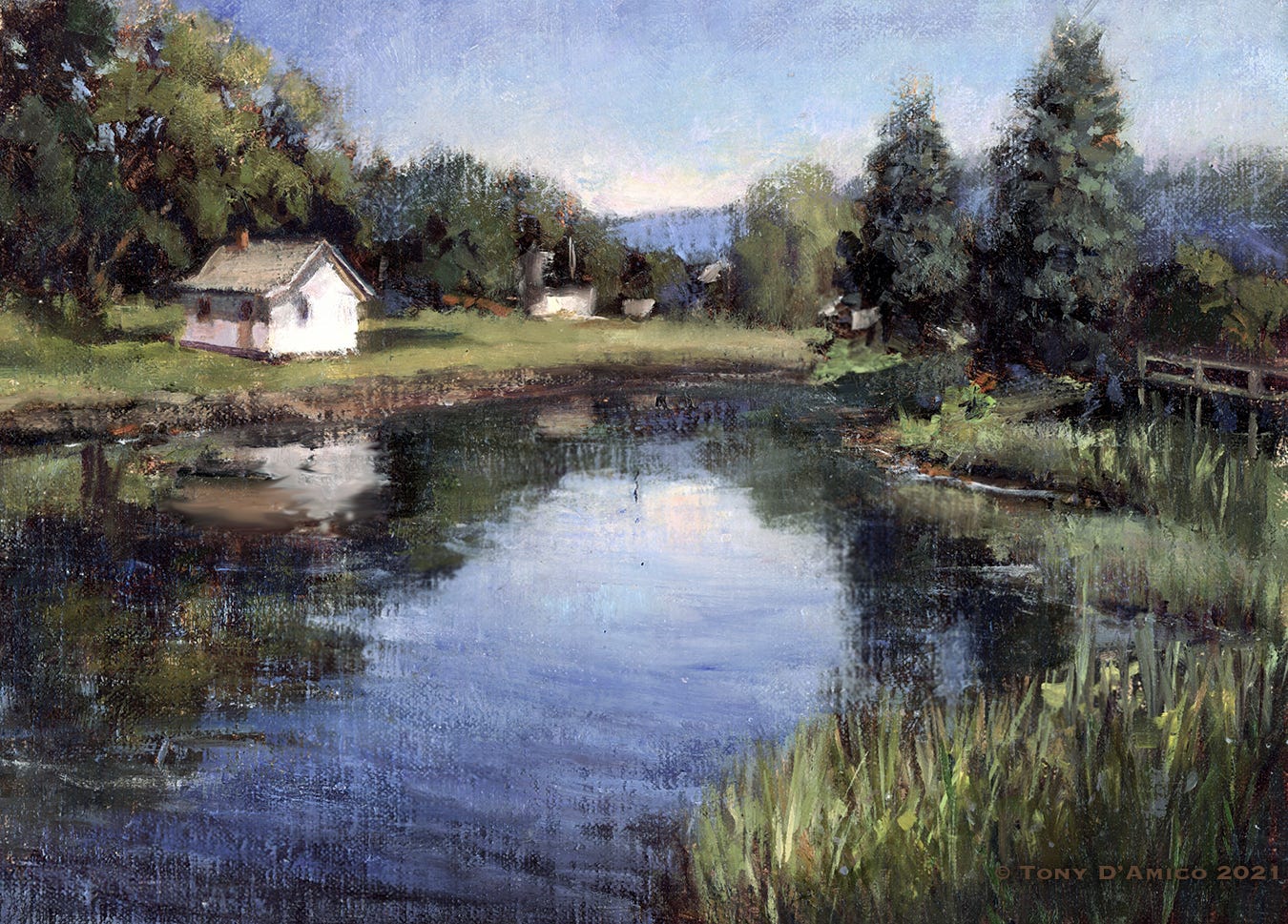
“I want to paint not just a place, but the overall experience of being there,” — Tony D’Amico
❤️ Please click the Like button—the little heart icon at the top and bottom—Your simple click directly supports our mission to fund and promote the arts for those who need it most. Tap the heart, pass the inspiration forward, and remember: the world needs your creative spark today.
A successful art career rarely emerges from talent alone. It develops through years of observation, experimentation, failure, self-critique, and sustained engagement with other artists and collectors. In his conversation with FASO Podcast host Laura Arango Baier, representational painter Tony D’Amico offers a candid account of that process.
D’Amico’s career has moved from technical illustration and commercial design to marketing, plein air painting, and full-time fine art. That varied experience has given him an unusually integrated perspective: He understands that artists must learn how to see, how to compose, how to communicate, and how to bring their work into the world.
Here are eight of the episode’s most important lessons.
1. Artistic growth begins when certainty ends.
D’Amico treats dissatisfaction as a productive force. He does not regard artistic development as a journey toward a final state of mastery, because every advance reveals another level of possibility. That outlook protects artists from complacency while allowing curiosity to remain stronger than ego.
“Keep your mind open,” D’Amico advises. “Never stop learning.”
This principle requires more than passively admiring accomplished artists. It means studying their decisions, asking why their paintings work, attending workshops, experimenting with unfamiliar materials, and returning continually to drawing and painting. The artist who assumes there is nothing left to learn has not completed the journey; that artist has simply stopped moving.
2. An artistic voice grows from sustained attention to what genuinely matters to the artist.
Artists are often told that they must identify a recognizable subject or style before they can develop a professional career. D’Amico offers a more expansive view. He paints city streets, coastal scenes, landscapes, interiors, and ordinary places because the unity in his work does not come from subject matter alone. It comes from his persistent interest in light, atmosphere, design, and lived experience.
“What is their passion?” he asks of artists who are searching for a direction. “What do they love doing?”
An artistic voice is therefore less like a brand you select in advance and more like a pattern discovered through repeated work. Artists find it by noticing which visual problems continue to fascinate them, which emotions they repeatedly attempt to translate, and which decisions feel unmistakably their own. Consistency can emerge from sensibility even when the subjects themselves remain diverse.
3. Strong paintings interpret experience instead of merely recording appearances.
D’Amico is drawn to places that many people might pass without noticing. His task is not simply to reproduce those locations accurately, but to uncover their latent drama. In one example, a technically sound painting of a New York hotel initially felt lifeless, so he transformed the street into a rain-slicked surface that reflected the surrounding lights. The change introduced atmosphere, movement, and narrative.
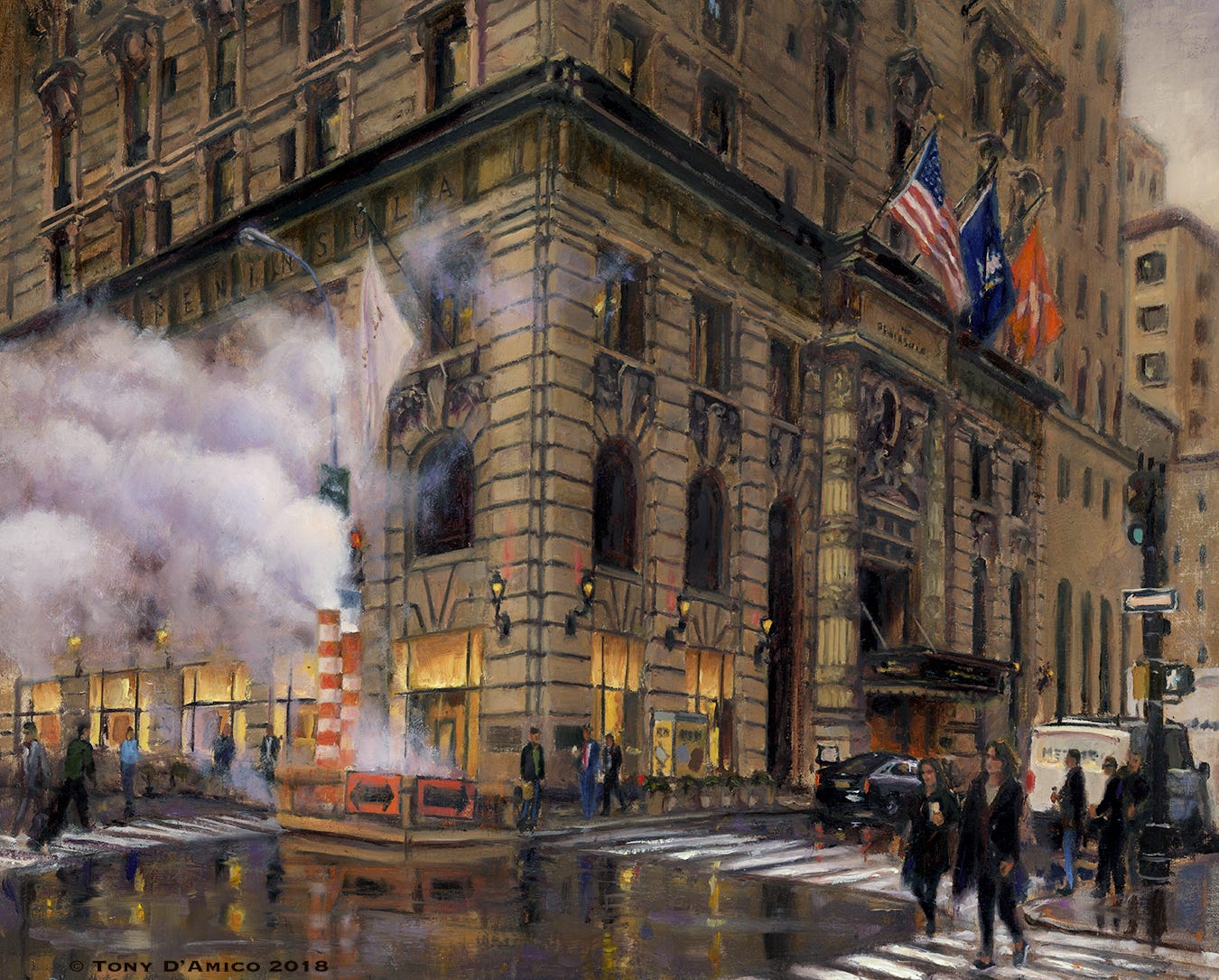
“I want to paint not just a place, but the overall experience of being there,” he explains.
This distinction separates documentation from interpretation. A successful representational painting does not have to inventory every visible fact. It must decide what deserves emphasis, what can be suppressed, and what can be altered to communicate the emotional truth of the scene. Accuracy describes what was present, but artistic intelligence determines what the viewer will experience.
4. Plein air painting teaches artists to see selectively and remember deeply.
Painting outdoors confronts the artist with an unstable world. Clouds move, tides shift, shadows lengthen, and atmospheric conditions change faster than they can be copied. Those limitations force the painter to identify the essential structure of a scene and commit to a particular moment.
“Painting outdoors forces you to simplify because the light and atmospheric conditions change so rapidly,” D’Amico says.
He describes his plein air paintings as “visual postcards” because they preserve more than visual information. Years later, a painting can recall the weather, sounds, sensations, and events of the day on which it was made. Those memories subsequently enter his studio paintings, giving them an authenticity that photographic reference alone cannot supply. Plein air work consequently becomes both an exercise in visual economy and a reservoir of embodied experience.
Your art deserves to be discovered.
As Tony D’Amico reminds us, creating strong work is only part of building an artistic career. Artists must also present that work professionally and help the right people find it.
FASO gives artists the tools to build a professional online presence, share the stories behind their paintings, stay connected with collectors, and turn attention into lasting relationships. As D’Amico says, “Marketing doesn’t replace good painting. It simply helps it find the right home.”
You have already devoted countless hours to developing your craft. Let FASO help you place that work in front of the people who will value it.
5. Composition must be designed before technique can become meaningful.
D’Amico plans his paintings deliberately. He uses thumbnails, photographs, and Photoshop to move elements, establish the value key, test relationships, and determine how the viewer will enter the image. When he neglects that preparatory work, he finds that the painting is more likely to fail.
“You could be a great technician and paint everything perfectly, but if it’s not compelling enough to invite that viewer in, it’s not going to be successful,” he says.
Technique can make every object convincing, but composition determines whether those objects form a meaningful whole. The strongest paintings are not merely accumulations of well-rendered parts. They establish hierarchy, direct attention, create tension, and leave enough mystery for the viewer to participate. Planning does not eliminate spontaneity; it gives spontaneous choices a structure within which they can matter.
6. A sustainable art career is usually built over decades rather than discovered overnight.
D’Amico’s move into fine art was gradual. After selling his design business, he continued consulting while devoting more time to painting. That transition provided stability as he improved his work, exhibited, and developed relationships with galleries, collectors, and fellow artists.
“Put ten years into it,” he tells impatient students. “Put ten or twenty years. That’s what it takes, and you’ve got to be willing to do that.”
This long horizon is an antidote to the distorted timelines presented online. Audiences frequently encounter the polished result of an artist’s development without seeing the years of study, abandoned paintings, workshops, financial uncertainty, and repetitive practice behind it. D’Amico’s account reframes patience as a professional skill. Serious artists do not wait passively for success, but they do allow enough time for competence, identity, and opportunity to mature together.
7. Marketing does not diminish good art; it helps good art reach the people prepared to value it.
D’Amico’s commercial background taught him that quality and visibility solve different problems. A painting must possess artistic merit, but merit alone cannot create an audience. If potential collectors never encounter the work, it cannot affect them or find a home.
“Marketing doesn’t replace good painting,” he says. “It simply helps it find the right home.”
For contemporary artists, this means maintaining a strong website, entering exhibitions, working constructively with galleries, sharing works in progress, and telling the stories behind individual paintings. D’Amico has found that collectors respond strongly to process because it allows them to understand the decisions and experiences embodied in the finished work.
The relationship also matters. When speaking with a potential collector, D’Amico recommends beginning with genuine curiosity and listening carefully. A conversation that does not produce an immediate sale can still produce familiarity, trust, or friendship. In that sense, effective art marketing is not aggressive persuasion. It is the patient creation of meaningful connections between the artwork, the artist, and the audience.
8. Rejection becomes useful when it is treated as information rather than identity.
Commercial art taught D’Amico how to separate rejection from paralysis. When a client declined a campaign, he developed another one. Rejection feels more personal in fine art because the work contains the artist’s own vision, but the underlying professional response can remain the same: The artist evaluates, adapts, and continues.
“One thing doesn’t get into one show and wins an award in another show,” he observes.
No single juror, gallery, exhibition, or collector possesses the authority to determine the absolute value of a painting. Decisions are shaped by taste, context, timing, available space, and the surrounding work. Artists should critique themselves honestly, but they should not confuse one external decision with a final verdict.
D’Amico’s answer is disciplined persistence. He recommends drawing and painting constantly, studying admired artists, investing in dependable materials, and using disappointment as motivation. As he concludes, “Talent helps, but it’s really discipline and observation, work ethic, and many hours at the easel that will build a satisfying career.”
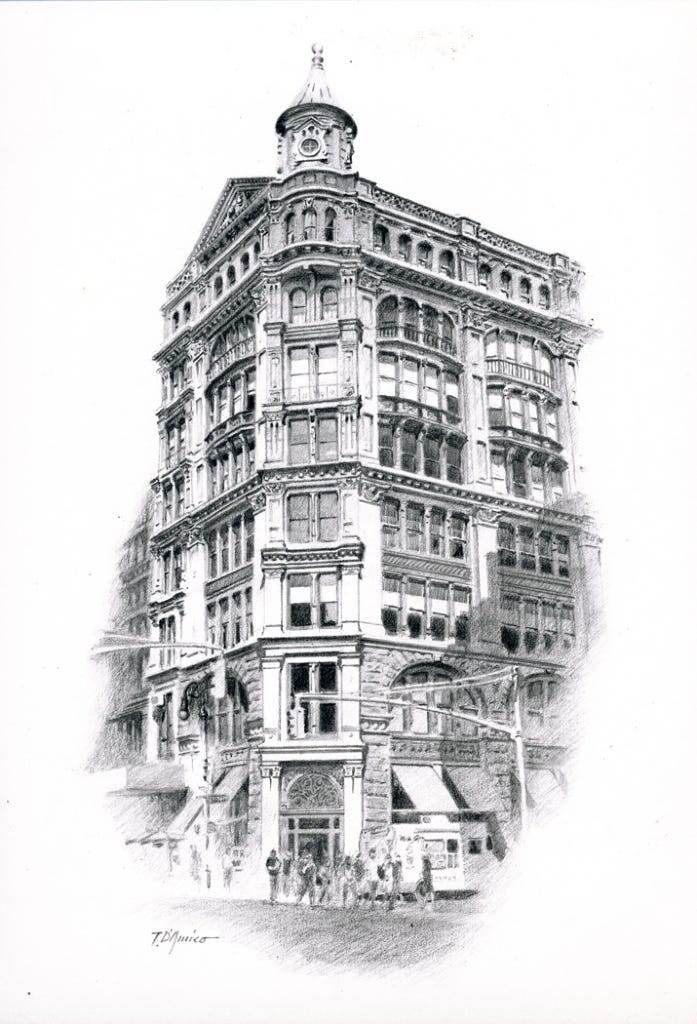
The artist’s real destination is continued development.
D’Amico’s career demonstrates that artistic maturity does not require curiosity to disappear. It requires curiosity to become more disciplined. Plein air painting sharpened his perception, design training strengthened his compositions, marketing taught him how to create opportunities, and rejection taught him how to continue without surrendering authority over his own work.
The central lesson of Episode 188 is therefore larger than the instruction to practice. Artists must remain active students of their craft, their subjects, their audiences, and themselves. They must be ambitious enough to pursue excellence and humble enough to understand that excellence will keep moving.
For D’Amico, that movement is not a source of frustration. It is what keeps the artistic life alive.
Want to hear the full conversations and insights from Tony? Listen to this episode of The FASO Podcast: Tony DAmico — Never Stop Learning
PS — Note from Clint: One of the reasons I built FASO is because I believe art is important, artists are important, and the work you’re called to create deserves to be taken seriously. We are all sharing “miracles of existence” through our art.
Yes, at FASO, we build professional artist websites. Yes, we talk about marketing. Yes, we give artists tools to present their work, tell their stories, reach collectors, and sell more art.
But that is the how.
The why is that we love art, and we want to push back against a world that too often treats art like content and artists like algorithms. The modern world denigrates Beauty in preference of profit and efficiency. At FASO, we hold Beauty sacred.
So we don’t just host artist websites. We promote artists. We feature their work. We try, in our own small way, to help more art find the people who need it. And that informs everything we do and build.
If that resonates with you, we’d be honored to have you join us.
PPS — If you’re not ready to look at FASO, you can support our mission by simply clicking the heart icon at the top or bottom of this article. That helps us reach more artists and art lovers and helps us spread Beauty to a world that is desperate for it.
—Clint
Our use of AI in this article: Our team worked with AI to help generate this summary and from there we manually edited it. Our beef with AI is primarily when it is used in a way that reduces opportunities for artists. Our goal, in the places we do utilize AI, is to use it in a way that supports human artists. And we believe this use case supports rather than harms.
At FASO, we do not train AI on your artwork for the purposes of using it to generate alternative images. We do use AI to protect your artwork from scrapers (including other AI bots) and to detect and block spam. And we are exploring the use of AI in ways that send more art lovers and collectors to our customers.
As always, The FASO Way is an open forum, so we’d love to know what your opinion of such AI use is in the comments. And, please, as we always request, all comments must be dignified and respectful of us and of your fellow artist colleagues who may have differing points of view. We are in this together, so discussion, and even debate, is important. But hateful or threatening comments will be blocked.