

The FASO Way newsletter — exploring how to thrive as an artist in the age of AI
Today’s Newsletter is Brought to You by FASO.
FASO Loves Eric Bowman’s paintings
SPRING SALE - SAVE 52% ON FASO FOR A LIMITED TIME
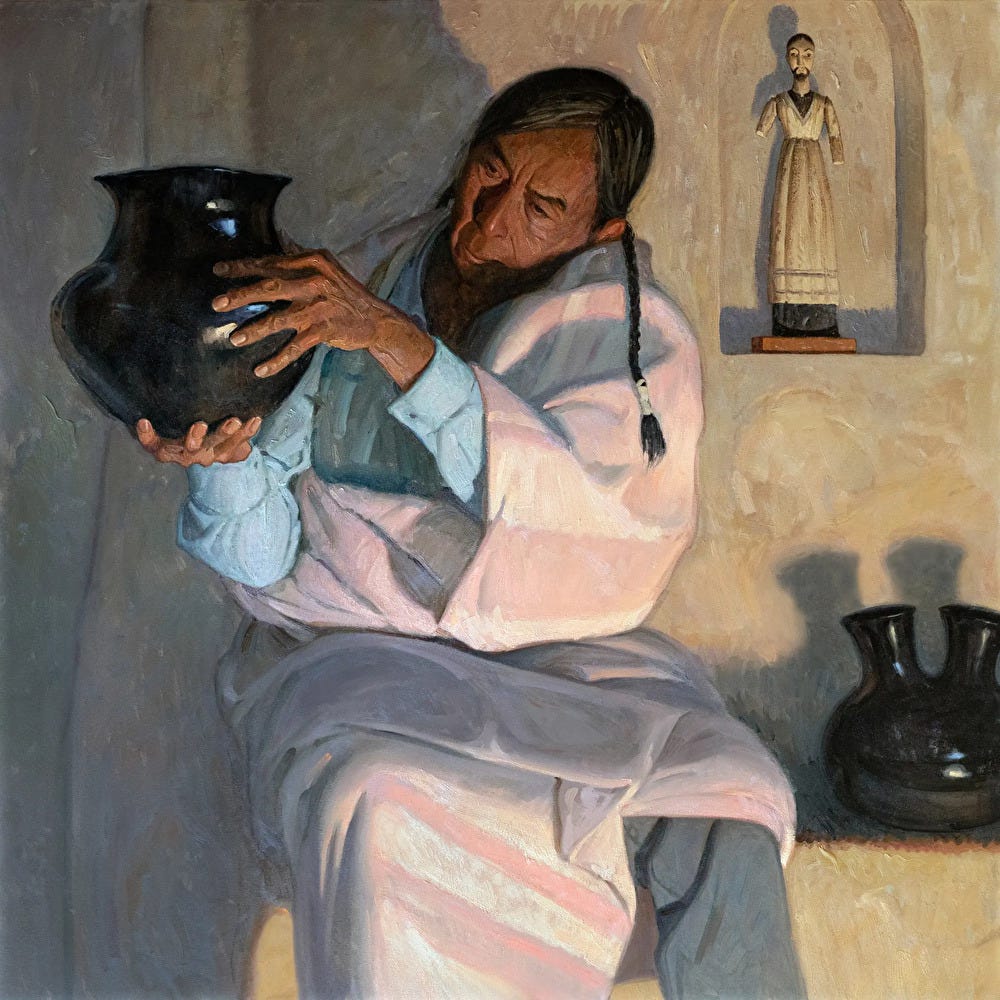
Wouldn’t You Love to work with a website hosting company that actually promotes their artists?
As you can see, at FASO, we actually do, and,
we are the only website host we know of that does.
Click the button below to start working
with an art website host that actually cares about art.
Just activate your account before before your trial expires to save 52% on your first year.
We have another post today by Eugene Terekhin, the man and the mind behind the publication Philosophy of Language.
Eugene is a regular contributing writer to The FASO Way.
This article will be locked in two days for paying members only.
Feature Article:
When Math Isn’t Enough: AI, Authenticity, and the Missing Fifth Element
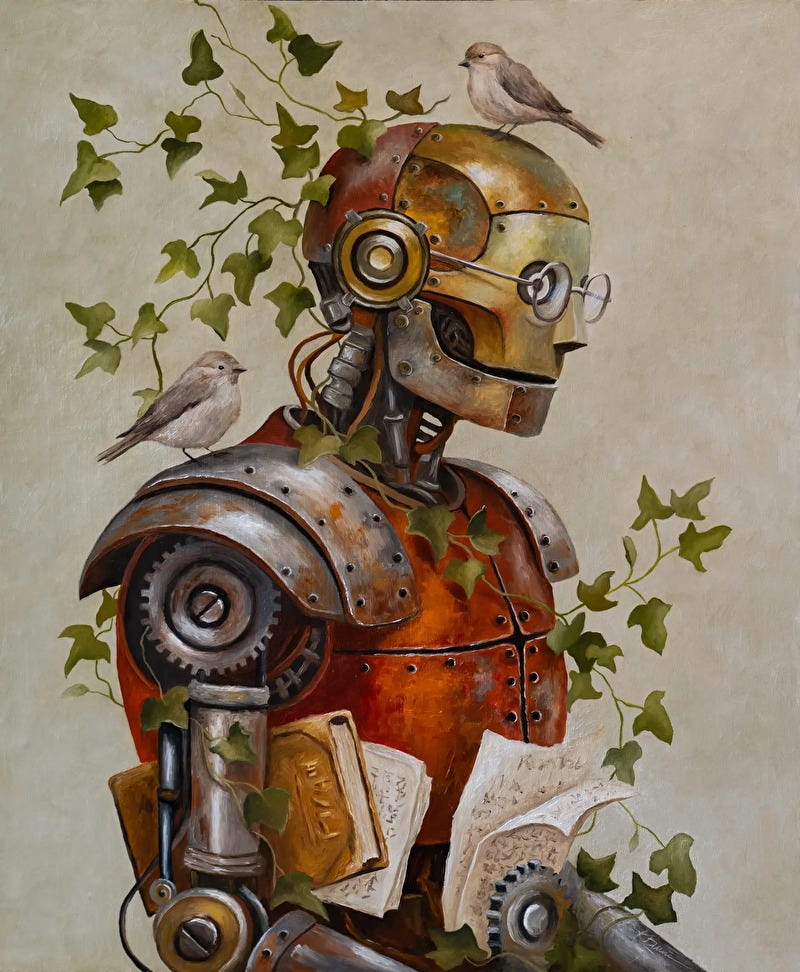
When AI first appeared several years ago, I thought that, over time, it would become increasingly difficult to distinguish between AI-generated and human-generated content.
Surprisingly, time shows that it is true and untrue at the same time.
It becomes harder to tell the difference only when we try to analyze what we see with our minds. When we rely solely on the intellect, we often miss it.
But when we rely on our guts, we rarely err. When we look at AI-generated content, we feel in our guts that something is off.
There is a curious psychological phenomenon we all share called the “uncanny valley.” Coined by roboticist Masahiro Mori in 1970, it describes a psychological phenomenon where human-like objects (robots, CGI, dolls) that appear almost, but not quite human, elicit feelings of eeriness, revulsion, or discomfort.
Most explanations of the uncanny valley suggest that the “dip” in affinity occurs when something looks nearly human but contains subtle imperfections. I would say the opposite. The dip in affinity occurs when something looks nearly human but way too perfect.
AI-generated content is mathematically precise. And mathematics deals with models, not reality. A model resembles the real thing – but in an overly precise, idealized way. A model apple may look exactly like a real one, but it is too perfect – and, of course, inedible.
Recently, YouTube served me a couple of videos about centenarians sharing the secret to a long life. The introduction was intriguing, so I started watching.
For the first two minutes or so, I assumed it was real – the old man, the story, the setting.
Then a vague feeling arose: something “felt off.” I had never seen even a 90-year-old move or speak like that – too perfect to be real. No fidgeting, no coughing, no irregular blinking or movement.
He never paused or hesitated between words or sentences. No sniffing, no searching for words, no trailing off mid-thought, no rasp or tremor in the voice.
His features were perfectly symmetrical.
His speech was flawlessly paced, each word evenly spaced – something a real person would rarely do unless highly trained in public speaking.
Even the background looked authentic, yet somehow artificial – too precise, too model-like.
I stopped the video. It immediately lost its appeal. Why would I listen to machine-generated life advice?
Scrolling through the comments, I saw the same reaction repeated: “It’s AI.”
What is this feeling we experience when something looks real but feels off? The mind cannot go beyond mathematics; the gut can.
It perceives what lies beyond the mathematical – the creative Spirit.
When we look at a real 100-year-old, we sense that living Spirit moving through him in unpredictable, imperfect ways: in the pauses, the sniffing, the blinking, the coughing, the small gestures.
A model cannot capture the living Spirit – that is why it feels lifeless. A mathematically generated reality does not nourish. Only what is alive can nourish the soul.
And the Spirit dwells in imperfect vessels. It hovers over the formless and brings it into living order:
“Now the earth was formless and empty, darkness was over the surface of the deep, and the Spirit of God was hovering over the waters.” – Genesis 1:2
We cannot contain or predict the Spirit. It does not fit into mathematical precision. It moves over the formless and brings it to life in the moment. It is the missing “fifth element” – the force that binds all things together.
That’s why recent data shows that AI gradually erodes trust between brands and people.
According to Forbes, about 55% of audiences feel uncomfortable with AI-generated content, especially in advertising and media.
PS - We know setting up or switching websites is a pain. But, in this day and age, you need your own home base.
And you need it to be with a company who cares about human artists. A company with actual artists who support you and who you can communicate with. A company that actually promotes their artists, as you can see that we do in this very newsletter. Frankly, that company is us, FASO. We stand up For Artful Souls Online.
A great website, contrary to what big tech says, is more important than ever.
So to make it easier for you, we’ve put together a special spring deal where you’ll get your first year on our platform for only $150. That’s a 52% savings off the normal price of $312/year. Think of it as us paying you $162 to move your website to a place that actually promotes human creativity. Just sign up for a trial account by clicking the button below and be sure to activate your account within the first 15 days of your trial.
Please take this opportunity to move away from platforms that use your hard work as “content” to serve hostile algorithms while they callously steal your artwork to train their AI systems. We are here, ready and waiting to help you regain your sovereignty. Please join us and thousands of other sovereign artists in this movement.
hi
I had a stroke in 2023 and sometime it looks as if I might be near the end of life
what happens to my FASO site after I die?
Liked this post, when I'm on Youtube , I leave a lot of comments saying "thumbs down for AI writing and voice, get a LIVE PERSON narrator" . . . I encourage everyone to do the same, and of course, hit THUMBS DOWN!