Who Told You to Stop Believing in Magic?
How to resume the most important quest to find your true self
This post may be truncated in some email clients. I encourage you to read it on the web at this link: Read full piece.
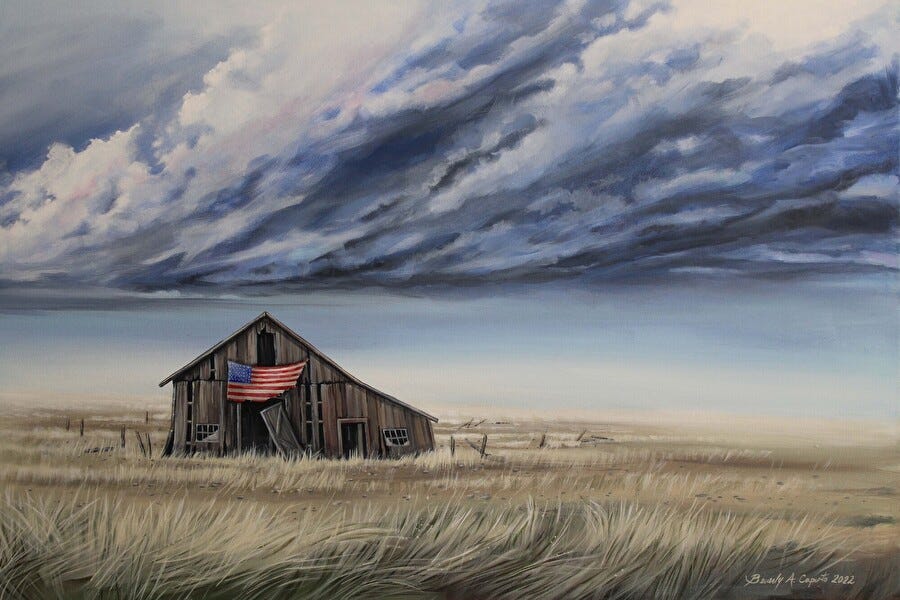
Happy 4th of July weekend! You’ll notice the ads in this newsletter feature art celebrating America. I encourage you to look at Beverly’s prints. They are extremely affordable.
FASO Loves Beverly Caputo’s Art
Wouldn’t You Love to work with a website hosting company that actually promotes their artists?
As you can see, at FASO, we actually do, and we are the only website host we know of that does.
Please click the button below to start working with an art website host that actually cares about its artists.
Who Told You to Stop Believing in Magic?
This piece originally appeared on Clint’s personal newsletter, The Universal Riddle, here. We will be locking this piece in a few days to prevent duplicate content issues.

When I was young, it seemed that life was so wonderful
A miracle, oh, it was beautiful, magical
And all the birds in the trees, well they’d be singing so happily
Oh, joyfully, oh, playfully watching me— Supertramp, The Logical Song
❤️ Please click the Like button—the little heart icon at the top and bottom—if you believe the world needs to be less “clinical, intellectual, cynical” and a little more magical, full of wonder, and for artists to remember who they are. Your click helps this quest reach more people — and helps us better promote the arts to those who need support.
When I was young, it seemed that life was so wonderful: I loved reading, dogs (and cats), adventures and, especially, quests. Growing up in a small town in northwest Arkansas in the 1970’s, I was afforded much freedom, even as a young boy. We lived out in the Ozark forest on a mountain: a perfect home base for questing.
Fueled on inspiration from reading Huckleberry Finn, or The Hardy Boys, I’d set out on Saturday mornings with my two blue tick hounds, Molly and Frosty, along with the little schnauzer (whom I creatively named Schnauzy) who always tried her best to keep up with the bigger dogs, and we’d head out into the woods, exploring. Or, I’d hop on my bike and meet up with friends for a day of shared adventure.
Nothing much happened on these adventures: we followed streams to their source, we found waterfalls emptying into magical pools, we had epic dirt-clod battles involving trench warfare on construction sites. We once made a sacred oath (that may have involved spit and blood) to follow the town creek as far as it went. We spent most of the day trying to construct a raft because we had reached a point where it became impossible to walk along the banks. Our parents found us there, after dark, still trying get our ratty raft — made of shipping palettes and milk cartons full of air — to float. Our parents found us and lectured us about water moccasins and responsibilities. They weren’t happy. But we were.
I say “nothing much” happened, but that’s not quite true. Plenty happened, in our imaginations, we were the heroes of our own stories. We imitated the art we read. And heroes save the world, or, at least, the day.

As I grew, I discovered Dungeons and Dragons, and my love of reading became voracious: The Chronicles of Narnia, The Hobbit, Lord of the Rings. More, and bigger, quests. When I ran out of things to read, I’d pick up whatever my dad had finished with: Piers Anthony fantasy books, Dune, numerous sci-fi novels, and several Stephen King books. And, the thing is, these worlds drew me in because they were far more interesting than the one I lived in.
Despite the fact that my friends and I were adventurous heroes on the weekends, the regular world was pretty dull by comparison: Homework, school, sitting inside all day, multiplication tables, conformity, rules, grades, competition.
I recall my first brush with the brutal world of the market-economy. For some kind of fundraiser, I was expected to go door-to-door and sell crappy chocolate bars.
Why would anyone want these? I wondered. I mean, it wasn’t like we were selling something awesome like Snickers bars. No. It was some off-brand produced “exclusively” for fundraisers. So, I walked up and down main street, after school, sullen, working up the courage to go into the shops to try and sell my crappy chocolate to the poor people that worked there.
I, the adventurer, the savior of damsels in distress, the hero, had been domesticated, and turned into the mundane symbol of everything that’s wrong with modernity: a salesman. In a turn of events that shocked nobody, I wasn’t very good at it.
You wouldn’t ask Buck Rogers to sell insurance, and those fundraisers shouldn’t have asked me to sell chocolate. I’m sure my parents either bought most of it or pawned it off on their friends.
My friends and I, after we discovered Dungeons and Dragons moved much of our adventuring fully into our imaginations. My character was usually an elf. I loved the combination of fighting skill plus the ability to cast spells, I mean if we’re entering an imaginary world, then of course there should be magic.
Through some course of events I can no longer recall, one day, I had to take over as the dungeon master. And, over the course of that day it began to dawn upon me, that I didn’t have to purchase D&D campaigns from TSR: I could create my own adventures.
I could create my own worlds.
And so I did.
I think that is the day I first became a writer, I just didn’t realize it yet.
Soon afterwards, my parents bought me my first computer, and I did the same thing: I created my own worlds.
I spent hours and hours learning to program just so that I could create my own text adventure games in the image of Zork.
That was writing.
That was creating.
That was Art.
Sure, it was a back door way into writing, and it took me on a long detour through the world of technology and software development for a large part of my career, out here, in the increasingly-devoid-of-magic “real” world, but it was world-building nonetheless. And there are worse ways to make a living than writing software. So I can’t complain, but, somewhere along the way, I lost sight of the magic. I lost sight of The God Spell. I lost sight of life.
When we are children, of course, we are full of imagination and creativity. We see wonder everywhere. We have ideas. We want to go on adventures. We want to save the world. So we play. We practice, in the ways that we can, for that future when maybe we can share our ideas in ways that help.
But, something has gone wrong. Somehow, we stopped encouraging such ideas. We are told to forget all the “nonsense.” We are told to be practical. We are told to be logical. Eventually we forget all that stuff and we “get serious.” We have bills to pay, after all.

Who are you to expect magic? Who are you to make things better? Did you expect to be free?
After all, “they” say, “it’s not work if you like doing it.”
Who are you to save the world?
But then they sent me away to teach me how to be sensible
Logical, oh, responsible, practical
And then they showed me a world where I could be so dependable
Oh, clinical, oh, intellectual, cynical— Supertramp, The Logical Song
But here’s the thing: we don’t actually forget all our wondrous ideas. We don’t forget the magic. We suppress it.
And that’s why people are so angry; why they are so clinical, oh, intellectual, cynical.
What I’ve discovered lately, and it makes all the difference, is simply this one tiny truth: you don’t have to suppress it.
So I stopped suppressing it and starting reading and, especially, writing again. I started creating again. I started living and telling stories again.

And, through that, I rediscovered the magic I thought I had lost forever. Apparently, you can reenter the garden. I finally became old enough — as C.S. Lewis wrote to his Goddaughter, Lucy Barfield, about Narnia — to start reading, and believing in, fairy tales again:
My Dear Lucy:
I wrote this story for you, but when I began it I had not realized that girls grow quicker than books. As a result you are already too old for fairy tales, and by the time it is printed and bound you will be older still. But some day you will be old enough to start reading fairy tales again.
Your affectionate Godfather, C. S. Lewis
That magic that most people have learned to suppress?
That is who we actually are, as artists.
That magic is our truth, and truth always has the power to set us free. Someone important; someone serious; someone who told us to be like children; someone who actually did save the world told us to remember that.
“The truth will set you free”
Free to do what?
Why to go on a quest, of course!
And this is the quest of the artist:
First, we embark upon a hero’s journey to find our True Self, our True Name.
Then, we save that True Self from the forces we’ve allowed to imprison it.
And finally, now armed once again with our full magic, we set out on an adventure to share the power of our imagination – our art – with others, so they too might awaken their own latent magic and thus help us in the important quest of saving the world.
And boy, does the world need saving, more than ever. Won’t you join us? What is your magic power? What magic do you share with your art?
There are times when all the world’s asleep
The questions run too deep
For such a simple man
Won’t you please, please tell me what we’ve learned?
I know it sounds absurd
Please tell me who I am?— Supertramp, The Logical Song

PS — The themes in this piece are the same ideas I explore in my forthcoming book, The Sovereign Artist. If that is of interest to you, please click here to join the waitlist.


